
Three reasons why I didn’t see myself in agriculture
“Did you always want to be on the ranch?” He asked, over eggs and coffee at the local diner.
“Not at all,” I replied, “it’s a more recent development.”
I debated on going into the specifics with this stranger of why ranching had never been on the top of my career list growing up, but thought I’d leave it at that.
In the tractor this morning, I got to thinking about all the reasons why I never really saw myself taking over the ranch. I decided on 3 main ones.
1: I didn’t know if I wanted to be a “ranch wife”
I heavily bought into the stereotype of the rancher’s wife. You know, the one that cooks and cleans and minds the children while John Wayne and his buddies do the cow wrangling? In reality, ranch women typically do both — which is a lot.
My misconception of women ranchers was heavily influenced by a media that doesn’t understand ranch life. But I also think the issue is more systemic. Women in ranching typically don’t identify as ranchers but self-label themselves as “ranch wives,” even when they do the same work their husbands do. There’s nothing wrong with the label of “ranch wife.” Domesticity is highly underrated. But at the time, I wasn’t a wife, or even a girlfriend. I think more women just simply saying that they’re ranchers, would help encourage people with warped view of the roles women play in ranch life.
It wasn’t that I couldn’t see myself doing ranch work, it’s that I couldn’t see a career in it, only a relationship. I always thought if I was going to take over the ranch, I was going to have to marry someone who would want to ranch with me. He’d call the shots and I’d be effectively an unpaid hired hand that cooked to boot. Either that, or I’d need more of a ceremonial head of state kind of a guy that people would listen to and respect while I made decisions in the background. I didn’t think it was possible to be a single woman rancher. This idea didn’t just come from nowhere. I had often heard off-hand comments like, “It’s too bad your dad doesn’t have any sons.” This translated to me as “you are biologically incapable of handling this ranch.” Which I am – alone. Anyone in ranching knows it can’t be done alone. Ranching is a group effort that requires multiple different skill sets. On the hard days, comments like that really got to me and I questioned my ability, my potential, and my place on land I now own. It took a long time to break out of my own idea of what women in ag should be like.
You know that popular quote people hang up on signs -“behind every successful ranch there’s a wife that works in town” ? It applies to husbands too. I’m married to a man who has little to no background in agriculture. His job in town provides outside income as well as health insurance for us both, something that ag families without jobs outside the ranch struggle to get. My husband, Nathan, also keeps me from getting too absorbed in the ranch world. He keeps me involved in the community and brings a fresh perspective. It’s also been so incredibly fun to introduce him to my world – a world a tried and true cowboy might not appreciate due to familiarity. He encourages me to have the confidence to step up to my responsibilities and own what I do as a career and not simply, “helping dad.”
2: Outside Opinions
I graduated college in 2019 with degrees in economics, Spanish, and business. I pursued these degrees, wanting nothing much to do with agriculture. I wrote melodramatic college scholarship essays about wanting to escape the desolate western lifestyle of my youth. But I realized with each passing year at university, a life outside of agriculture proved far more desolate than the open landscapes of Northern Butte County. At the end of those four years, I felt the magnetic pull of the plains — for adventure, for physical challenge. On the drive back home from college, I felt a little of what woman homesteader May Holaday did as she crossed the Rockies to lay her claim: “straight away my former ideas of the importance of class distinction and the observance of social conventions seemed to fall from me like a heavy cloak, which had long been a burden –and I was free.” (Hensley, 31) Ranch life became an open door to adventure, self-actualization, and freedom from the social strings I allowed myself to be pupeteered by for so long. But some of those strings, although severed, were very much still jerking me around.
Many people seemed disappointed when I told them I was back on the ranch. I’ve always been the academic type and coming home just wasn’t what people expected me to do. A lot of people tried to encourage me to go back to school for an MBA or JD or anything but stay on the place. But in all honesty, I was completely burnt out academically. I love learning, but it no longer felt real to me. I wasn’t applying what I was learning into concrete action, and I couldn’t fathom the idea of more assignments for mere digital grades on a screen. College helped me see the ranch in a new way, and I wanted to be a part of it for the first time in my life. It was discouraging to have people tell me “you could be earning so much more money,” “this is the time to get a career, then you can ranch later” or “you’re wasting your talents in the middle of nowhere.” I started to believe them, too. I wondered if I was my dad’s son and not his daughter if I’d be hearing this kind of advice. I was sick of feeling like I didn’t belong, or wasn’t successful. My ego still longed for societal acceptance. I took another job.
3: Personal Insecurity
I was extremely insecure about my abilities on the ranch coming out of college. I had never really taken the time growing up to learn basic things like driving a tractor, roping a cow, or doing Quickbooks. I didn’t truly envision myself doing it all the time, so why learn? I took imperfections as a sign that I was a failure and not up for the job. But in reality, things just take time to learn.
I was also denying my individuality. I tried to be a rugged ranch girl all the while living up to the “rancher’s wife” narrative. I put way too much pressure on myself to know everything about ranching as well as cook for every single ranch event – brandings, shearings, dockings. It was too much. I also just felt funny. I was never really one of the “ranchy” kids growing up. I mean, I spent my entire summers running around on horseback, sleeping in the sheep wagon, and herding sheep and cows for miles, but I wasn’t really ever a part of the ranch crowd. I’d way rather be in a play than a rodeo any day. I’d rather listen to alternative than country music. I felt like my personality wasn’t suited for ranching, when really I just didn’t fit a stereotype of ranch women.
A job teaching Spanish at a local Christian School came up and I eagerly took the opportunity to get back into the more comfortable world of academia. Those three years did so much for me and my self -esteem. 8th graders are especially helpful in this department. They will say whatever they’re thinking right to your face. You get tough. They’re actually quite inspiring creatures. They say and do what they want, darn the consequences. I sought to lose the giant filter suffocating my own thoughts and actions.
While teaching, I fell back in love with agriculture. I taught it nearly everyday in some capacity. Agriculture has left an indelible mark on every subject — from Economics to English. One year, I taught a high school American Literature course. There’s such a deep agricultural heart to so many of those authors. Writers like Thoreau, Frost, Cather, and Emerson made me feel such a hunger to return to a life of simplicity in nature. I craved my own acres of inspiration again – but this time, for myself and not to placate anyone’s wishes for my life.
Concluding Thoughts
To be involved in agriculture, you have to be okay with yourself. Your mind must be a friend to you. You will not be happy riding alone to gather sheep to new pastures under an enormous sunset. You will not enjoy taking the feed truck out on a shiny winter day to feed cake to the cows. You will not recognize the grass reaching up to praise God as you ride through it. If you don’t have peace, you will be consumed with thoughts of self and who that self ought to do and be and who to please.
I don’t want other women to believe they have to be a certain kind of woman to make it in ag like I did. We absolutely have to encourage the next generation of women that find themselves with a ranch or farm to step up to the plate and take a swing, in their own way. We should applaud each base taken and give support to all the strikes that inevitably come. Why? Right now I can name so many families whose children have no interest in returning to the ranch. I wonder how many of them are daughters who never saw a place for themselves within the confines of a stereotype. I wonder how many people told them that life outside the farm is better, more prestigious.
Agriculture is safer in the caring hands of individuals and not in the exploitative hands of large corporations and overseas ownership. Inherited farms and ranches are sold all the time, not as treasured homes but properties. I don’t think it’s lofty to say the future of America is entwined with the health of rural soil. So let’s encourage as many people as we can to get involved and not drive away women from the playing field. The world needs healthy grass fed beef that clip the grass to let more carbon in each blade and sheep that sequester carbon in their wool, and provide fabrics that won’t disintigrate into synthetic waste in the ocean. It’s not just about women empowerment, it’s a global health and environmental crisis.
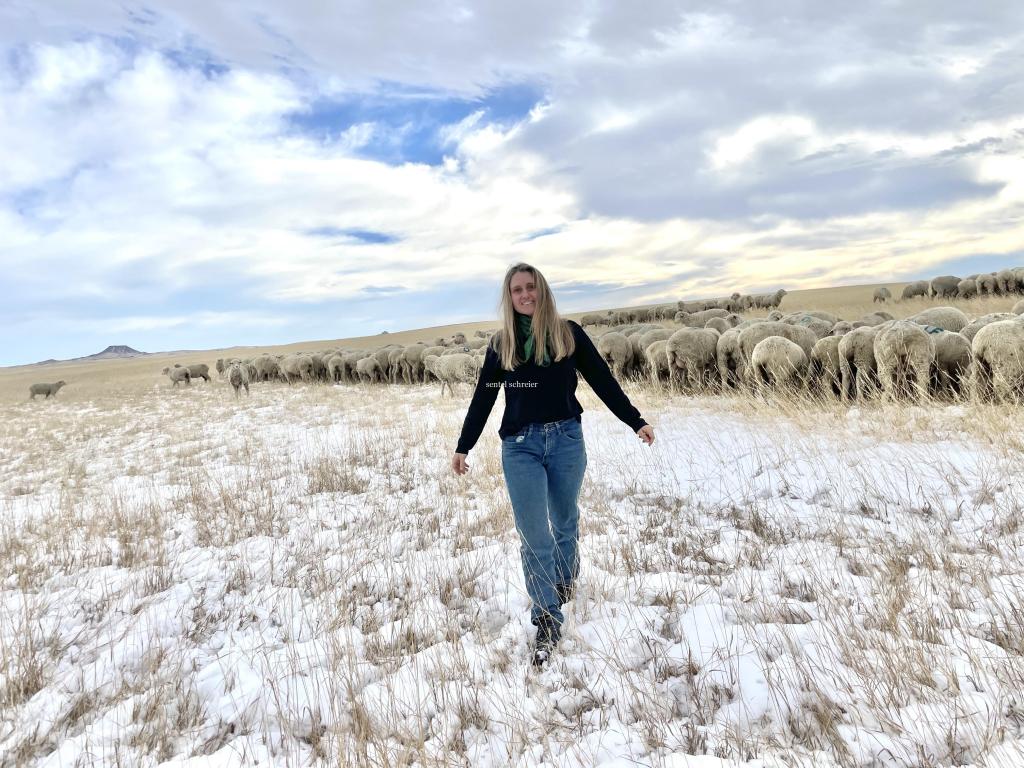
 Sentel Schreier
Leave a Reply